Another Road to Morocco
Posted by: admin on May 14, 2013, One Comment
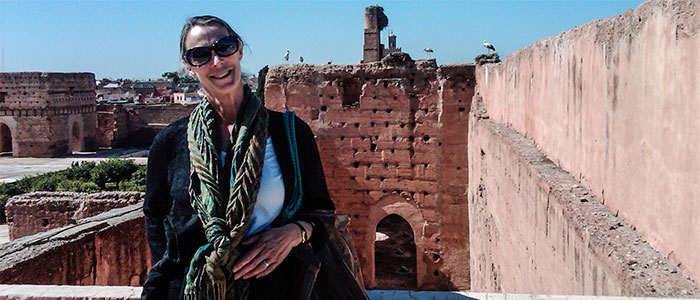
Kim McKay was ready. She had filled an entire semester’s worth of her year-long sabbatical with books in Arabic literature and research in Middle Eastern culture and history. She had studied her way to a basic grasp of the Arabic language, focusing on the Egyptian dialect. As a capstone experience, she made arrangements with Global Exchange, an international human rights organization, for an educational tour of Egypt after the Arab Spring. Dr. Kim McKay, associate professor of English at ESU was set; nothing short of a revolution could stop her now.
When the Arab Spring revolution exploded in 2010, the Arab world, including Egypt, shook to its foundation. In cities of over a dozen countries, demonstrations, sometimes violent, became nearly the norm. The ongoing social unrest brought the downfall of rulers whose long-held power was once thought untouchable. Fresh protests erupted in Egypt near the close of 2012; soon after, Global Exchange, with everyone’s safety in mind, canceled the trip.
Up until the cancellation, McKay remained undaunted. “I kept saying, ‘I’m going anyway, I’m going anyway,’” the professor recalls, grinning. Turning serious again, though, she admits the organization made the right decision. Still, she was too psyched to shelve the idea of a month in the Mideast.
“I found a group on the Internet called International Volunteer HQ,” McKay says. Although currently they had no opportunities in Egypt, they did need volunteers in Morocco. McKay was in. “It was as close to the Middle East as I could get,” she says, “without actually being in the Middle East. Plus, I could speak French there.”
McKay stayed in an ancient section of Rabat, the capital city. For the first week, she joined IVHQ’s Women’s Empowerment program. The term might sound rather grand, McKay says, “but the description of the volunteer program was much more accurate: teaching sewing, computer skills, and arts and crafts. I guess they [the government’s Agency for the Education of Young Women, who established the center where she volunteered] reasoned that if women learn to sew, type, or create something, they would have a trade and could earn money – and thus be more independent. For these women, financial power is synonymous with ‘empowerment.’” While her skills were thirty years old and based on Western equipment, McKay “taught” sewing the best she could, using nothing but scissors and a needle and thread. Yet she believes that simply being there every day with the women, encouraging them, making friends, and talking about their lives and her life in the U.S., was somehow empowering, especially for the younger women.
After that first week, though, McKay fulfilled a request from a neighboring town to teach what she knows best. For the remaining three weeks of her stay in Morocco, she taught English and American culture to public high school students in a disadvantaged community a short tram ride from Rabat. There she felt that she was having more of an impact on the Moroccan community, which she came to love during her stay. “Living with a family, sharing meals, and speaking a mix of French and Arabic with them further solidified my engagement in the culture and the people,” she says.
McKay would return to Morocco in the proverbial heartbeat, but duty calls here at home; and her sabbatical ends with summer 2013. Still, she is thankful for the time the University, whose students she has been teaching for the past 25 years, has given her. “Having this year off has been of incredible value in many ways to me as a faculty member,” she says. “And the opportunity to spend the month in Morocco was a direct result of that time off from teaching, which is quite wholly consuming. Just living in such a different culture, you fill your eyes with it so much that after a while it is not so different anymore at all. It is the same. At the most elementary level, that’s been a huge gain for me, and, therefore, for my ESU students of the future.”
Her students, like many people in our culture in these troubled times, are often wary of the Arab world. “There’s a real feeling that we have to have a wall between us,” McKay commented. “By continuing to talk about that other world, though, the context soon becomes larger and larger, and the hope is that one day it’s not a conversation you need to have anymore.” Since she introduces the Arab world, not only in her advanced literature classes but also in her freshmen in composition classes, McKay seeks to keep everyone talking and learning about the larger human experience.
One Response to “Another Road to Morocco”
Search
Recent Posts

ESU Students Attend Academic Seminar on National Security in Washington, D.C.
May 28, 2026 - Read more


Social Media


Sarah
Posted May 16, 2013 at 11:25 AM
Thank you Dr. McKay for helping to build bridges and fostering understanding between students in ESU with the lives of those around the world. We’re all humans and like you said, hopefully it’ll be a conversation we won’t need to have anymore.
🙂